Showing posts with label 1998 Films. Show all posts

Thursday, August 16, 2018

Short Take: Great Expectations (1998)

Director Alfonso Cuarón's modern-day Great Expectations is a fine, and occasionally magical, reworking of the Charles Dickens novel. The screenplay, credited to Mitch Glazer, moves the story to the late-20th-century United States. In the prologue, a working-class boy, who lives with his uncle (Chris Cooper) on Florida's Gulf Coast, is kidnapped by a fugitive convict (Robert De Niro) and forced to help him with his escape. Shortly thereafter, a wealthy local spinster (Anne Bancroft) arranges for the boy to be a companion for a beautiful niece the same age. The two (played from adolescence on by Ethan Hawke and Gwyneth Paltrow) are constants in each other's life for the next several years. They part ways when she leaves for college. He has fallen in love with her, but she doesn't quite reciprocate his feelings. Years later, he's put her behind him, and is working alongside his uncle as a fisherman and handyman. That's when his life is upended. He was an aspiring artist as a boy, and an unknown benefactor has arranged for him to move to Manhattan and prepare a gallery show of his work. Once there, he enters high-society circles and meets up again with the niece. This time, he is determined to win her heart once and for all. He also encounters the convict, whose revelations forever change his perception of his life. Cuarón and Glazer revise aspects of the book beyond the setting, such as making the protagonist an aspiring artist. (In the novel, he becomes a member of the idle rich.) But they also do powerful justice to the novel's emotional hooks, particularly the class insecurity that both gives the protagonist his ambition and is behind his worst behavior. Visually, the picture is gorgeous. Dickens' work, despite its social-realist trappings, has a distinct fairy-tale quality. Cuarón, working with production designer Tony Burrough and the master cinematographer Emmanuel Lubezki, saturate the imagery with that tone. The Florida scenes have a verdant, near-Edenic look, with the spinster's mansion seeming as if nature had all but reclaimed it. The film's Manhattan has a dreamlike Gothic quality, particularly in the nighttime scenes. The protagonist's apartment appears firelit, and the city outside is like an enchanted forest. The cast is a mixed bag. Ethan Hawke and Gwyneth Paltrow are disappointingly bland. (Jeremy James Kissner and Raquel Beaudene, who play the characters as children, are far more vivid.) Anne Bancroft turns the spinster into a campy Carol Channing impression. Robert De Niro is fine in terms of his individual scenes, but the performance doesn't add up to a coherent whole. Chris Cooper is the strongest of the players; he makes the uncle a grounded and affecting presence. (The scene where the uncle shows up uninvited to the gallery show is the most wrenching in the film.) One may also find Cuarón's handling of sex a bit too explicit. But it's an enchanting effort overall, and its daring makes it among the finest Dickens adaptations on film. The protagonist's artwork is by the Italian painter Francesco Clemente.

Wednesday, August 15, 2018

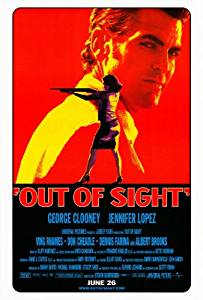
Short Take: Out of Sight

Out of Sight, directed by Steven Soderbergh, is a crackerjack entertainment. Based on the novel by Elmore Leonard, it’s both romantic comedy and crime drama, but the romantic comedy dominates. Serial bank robber Jack Foley (George Clooney) breaks out of a Florida prison, and as part of the escape, he is forced to briefly abduct a U. S. Marshal (Jennifer Lopez). The two are locked together in a car trunk during his getaway--probably the oddest meet-cute in Hollywood history--and they fall in love. They can’t stop thinking about each other afterward. He’s off to Michigan to pull the proverbial one last score, and she’s hot on his trail, but it’s not clear whether she’s out to capture him, romance him, or both. The thought of romance appeals to him, and he lets her stay close, but not close enough to make an arrest. (The film’s big romantic moment is the one time he decides to take his chances.) Clooney and Lopez have terrific chemistry, and neither has ever been better on screen. Both radiate intelligence, and her sexy no-nonsense toughness perfectly complements his trademark roguish charm. The screenplay, credited to Scott Frank, retains the novel’s sharp, witty dialogue and its terrific character ensemble. Each member of the large supporting cast--Nancy Allen, Albert Brooks, Paul Calderón, Don Cheadle, Viola Davis, Dennis Farina, Luis Guzmán, Samuel L. Jackson, Catherine Keener, Ving Rhames, Steve Zahn--gets a chance to shine, and they shine bright. Soderbergh’s direction is sleek, stylish, and never in a hurry. He seems to know a viewer wants to enjoy these characters for as long as possible. When he makes a point of showing his directorial hand, as he does with the film’s editing flourishes, the effects tend to be in the material’s spirit: both funny and romantic. Elliot Davis provided the cinematography, which is color-coded to the Florida, Michigan, and Texas locales. The editing is credited to Anne V. Coates. The musical score is by David Holmes.