
Showing posts with label 1966 Films. Show all posts
Showing posts with label 1966 Films. Show all posts
Friday, September 14, 2018
Short Take: Blow-Up

Friday, May 20, 2016
Film Review: Made in U. S. A.
This review was originally published at The Hooded Utilitarian on August 16, 2012.
 Made in U. S. A., Jean-Luc Godard’s 12th feature, had its North American premiere at the 1967 New York Film Festival. It wasn’t available for viewing again in the United States until 2009. The film is ostensibly an adaptation of the crime novel The Jugger, written by Donald E. Westlake under his pseudonym Richard Stark. But Godard and producer Georges de Beauregard failed to properly secure the rights. Westlake got an injunction that barred U. S. distribution of the film until after his death in 2008. As such, the film was long an object of curiosity among American film scholars, critics, and other cinephiles. Curiosity has now been sated, and it wasn’t worth the wait.
Made in U. S. A. embodies the meaning of the term “Godardian” when used as an insult. It’s self-indulgent, overly cerebral, and aggressively incoherent. Godard lards it up with in-jokes and other trite allusions. His obsession with Hollywood crime movies is very much on display, but only insofar as he can rub the viewer’s nose in the emptiness of their conventions.
The story’s main character is played by Anna Karina. It’s not clear if she’s a detective, a reporter, or a spy. She’s come to “Atlantic-Cité” to investigate the death of an old boyfriend, who may have been a deputy to a Communist local mayor who was killed in a mysterious explosion. The boyfriend allegedly died of heart failure, but the Karina character refuses to believe it. As near as I can tell, her investigation manages to get her on the wrong side of a corrupt political conspiracy that’s somehow tied up with societal revolutionary efforts, but don’t quote me on it. Godard keeps it opaque. As Karina’s character says at one point, “This affair had to remain murky for everyone.”
And oh, how Godard murks it up. There are repeated dialogues that portentously refer to sinister goings-on, but the viewer is never told what those goings-on are. Here’s a typical exchange:
“Now tell me things I don’t know”
“You know it’s a secret.”
“What secret?”
“Come on. Don’t start that again.”
Other dialogues veer into absurdist non sequiturs, such as when a writer the Karina character meets starts talking about how rarely he gets to see his girlfriend--only every day at breakfast, lunch, tea, dinner, and a movie or play in the evening. There are times when Godard doesn’t let the viewer hear the dialogue at all. In one scene, the Karina character questions a woman at gunpoint. But Godard drops all the sound, and one never finds out what was said. Godard also repeatedly introduces narrative red herrings. In a barroom scene, Marianne Faithfull appears as a patron, and apropos of nothing begins singing a song while the Karina character and the film’s two heavies (Laszló Szábó and Jean-Pierre Léaud) cast furtive glances at each other. Why? One never knows. Later on, the Karina and Szábó characters listen to a tape that supposedly tells them something, but it’s nothing but gibberish about colonialism, fascism, and revolution. And on and on. I suppose there's a similarity in some of this to the techniques of Samuel Beckett, but Beckett's work reflects a philosophical worldview. Godard isn't connecting to anything profound in the least; he's just screwing around.
It can be argued that Made in U. S. A. is to the crime/detective genre what Godard’s infinitely superior A Woman Is a Woman is to the Hollywood musical. That is, Godard is rendering the idea of a film in the genre, rather than making a film in the genre per se. The films' initial strategies appear the same: Godard introduces the tropes of the genre, but never follows through with them. With A Woman Is a Woman, this meant tantalizing the viewer with the prospect of singing and dancing while never actually providing any. Made in U. S. A. has hard-boiled dialogue, confrontations at gunpoint, and hints of a deeper conspiracy, but they never really connect to an overarching plot. That last aspect may be the key difference between the two pictures: for all the red herrings, A Woman Is a Woman has a reasonably accessible story. One doesn’t watch it feeling lost most of the time. And most of what was provided in the place of the singing and dancing was energetic and funny. Made in U. S. A., in contrast, just lays there. The only suspense is in wondering what bewildering absurdist nothing is going to happen next.
Another key difference is how the films use Anna Karina. In A Woman Is a Woman, Godard shaped the character around Karina’s personality and talent. He made enchanting use of her free-spirited charm and her astonishingly fluid expressiveness. The Anna Karina of A Woman Is a Woman is a star. In Made in U. S. A., Godard turns her into a stoic blank. The role is obviously a take-off on the taciturn Hammett-Chandler detective cliché, probably best embodied by Humphrey Bogart. But Bogart made those characters work through suggestions of anger, impatience, and disgust. He made you feel the character had earned his world-weary cynicism. The woefully miscast Karina doesn’t make the viewer feel anything; she just sullenly goes through the motions. She changes outfits more often than she changes expressions. The most that can be said for her is that she looks trés chic in those colorful dresses and white trenchcoat.
Made in U. S. A. is such a stultifying mess that it manages to undercut even the good things it has in common with Godard’s better films. Godard and his great cinematographer Raoul Coutard shot the picture in color, and it has the same bold, Pop look as Contempt and Pierrot le fou. But the film’s striking visuals quickly come to feel empty and mannered. Those gorgeously crisp images set a terrific stage for substantial material in the earlier films. Godard and Coutard got the viewer looking, and they made good on the promise to offer something worth looking at. Here, with nothing but pretense that quickly becomes insipid, those visuals feel like a bait-and-switch. Godard turns them into décor, and it’s hard not to feel cheated.
The heart of what goes wrong may be that Godard no longer had any emotional or romantic connection with what he was showing on the screen. The crime genre is a set of conventions he knows, but he’s so apathetic to them that he can’t even give them an effective razzing. There is no longer any rapport with Karina as a performer; it’s no surprise the two never again worked together on a feature-length project. No matter what, Godard cannot seem to imagine this material in terms of any known or felt experience. That may be why so much of the picture is preoccupied with irrelevant in-jokes and word games. If one wants to see what artistic decadence looks like, one doesn't need to go any further than Made in U. S. A.
Reviews of other films by Jean-Luc Godard:
Made in U. S. A. embodies the meaning of the term “Godardian” when used as an insult. It’s self-indulgent, overly cerebral, and aggressively incoherent. Godard lards it up with in-jokes and other trite allusions. His obsession with Hollywood crime movies is very much on display, but only insofar as he can rub the viewer’s nose in the emptiness of their conventions.
The story’s main character is played by Anna Karina. It’s not clear if she’s a detective, a reporter, or a spy. She’s come to “Atlantic-Cité” to investigate the death of an old boyfriend, who may have been a deputy to a Communist local mayor who was killed in a mysterious explosion. The boyfriend allegedly died of heart failure, but the Karina character refuses to believe it. As near as I can tell, her investigation manages to get her on the wrong side of a corrupt political conspiracy that’s somehow tied up with societal revolutionary efforts, but don’t quote me on it. Godard keeps it opaque. As Karina’s character says at one point, “This affair had to remain murky for everyone.”
And oh, how Godard murks it up. There are repeated dialogues that portentously refer to sinister goings-on, but the viewer is never told what those goings-on are. Here’s a typical exchange:
“Now tell me things I don’t know”
“You know it’s a secret.”
“What secret?”
“Come on. Don’t start that again.”
Other dialogues veer into absurdist non sequiturs, such as when a writer the Karina character meets starts talking about how rarely he gets to see his girlfriend--only every day at breakfast, lunch, tea, dinner, and a movie or play in the evening. There are times when Godard doesn’t let the viewer hear the dialogue at all. In one scene, the Karina character questions a woman at gunpoint. But Godard drops all the sound, and one never finds out what was said. Godard also repeatedly introduces narrative red herrings. In a barroom scene, Marianne Faithfull appears as a patron, and apropos of nothing begins singing a song while the Karina character and the film’s two heavies (Laszló Szábó and Jean-Pierre Léaud) cast furtive glances at each other. Why? One never knows. Later on, the Karina and Szábó characters listen to a tape that supposedly tells them something, but it’s nothing but gibberish about colonialism, fascism, and revolution. And on and on. I suppose there's a similarity in some of this to the techniques of Samuel Beckett, but Beckett's work reflects a philosophical worldview. Godard isn't connecting to anything profound in the least; he's just screwing around.
It can be argued that Made in U. S. A. is to the crime/detective genre what Godard’s infinitely superior A Woman Is a Woman is to the Hollywood musical. That is, Godard is rendering the idea of a film in the genre, rather than making a film in the genre per se. The films' initial strategies appear the same: Godard introduces the tropes of the genre, but never follows through with them. With A Woman Is a Woman, this meant tantalizing the viewer with the prospect of singing and dancing while never actually providing any. Made in U. S. A. has hard-boiled dialogue, confrontations at gunpoint, and hints of a deeper conspiracy, but they never really connect to an overarching plot. That last aspect may be the key difference between the two pictures: for all the red herrings, A Woman Is a Woman has a reasonably accessible story. One doesn’t watch it feeling lost most of the time. And most of what was provided in the place of the singing and dancing was energetic and funny. Made in U. S. A., in contrast, just lays there. The only suspense is in wondering what bewildering absurdist nothing is going to happen next.
Another key difference is how the films use Anna Karina. In A Woman Is a Woman, Godard shaped the character around Karina’s personality and talent. He made enchanting use of her free-spirited charm and her astonishingly fluid expressiveness. The Anna Karina of A Woman Is a Woman is a star. In Made in U. S. A., Godard turns her into a stoic blank. The role is obviously a take-off on the taciturn Hammett-Chandler detective cliché, probably best embodied by Humphrey Bogart. But Bogart made those characters work through suggestions of anger, impatience, and disgust. He made you feel the character had earned his world-weary cynicism. The woefully miscast Karina doesn’t make the viewer feel anything; she just sullenly goes through the motions. She changes outfits more often than she changes expressions. The most that can be said for her is that she looks trés chic in those colorful dresses and white trenchcoat.
Made in U. S. A. is such a stultifying mess that it manages to undercut even the good things it has in common with Godard’s better films. Godard and his great cinematographer Raoul Coutard shot the picture in color, and it has the same bold, Pop look as Contempt and Pierrot le fou. But the film’s striking visuals quickly come to feel empty and mannered. Those gorgeously crisp images set a terrific stage for substantial material in the earlier films. Godard and Coutard got the viewer looking, and they made good on the promise to offer something worth looking at. Here, with nothing but pretense that quickly becomes insipid, those visuals feel like a bait-and-switch. Godard turns them into décor, and it’s hard not to feel cheated.
The heart of what goes wrong may be that Godard no longer had any emotional or romantic connection with what he was showing on the screen. The crime genre is a set of conventions he knows, but he’s so apathetic to them that he can’t even give them an effective razzing. There is no longer any rapport with Karina as a performer; it’s no surprise the two never again worked together on a feature-length project. No matter what, Godard cannot seem to imagine this material in terms of any known or felt experience. That may be why so much of the picture is preoccupied with irrelevant in-jokes and word games. If one wants to see what artistic decadence looks like, one doesn't need to go any further than Made in U. S. A.
Reviews of other films by Jean-Luc Godard:
- Alphaville
- Band of Outsiders
- Breathless
- Les Carabiniers
- Contempt (Le Mépris)
- Une Femme Mariée (A Married Woman)
- First Name: Carmen
- Le Petit soldat
- Vivre sa vie (My Life to Live)
- Weekend
- A Woman Is a Woman
Monday, March 18, 2013
Short Take: The Professionals
This review was originally published on Pol Culture.
The 1966 Hollywood western The Professionals was extremely well received at the time of its release. It was favorably reviewed and a solid box-office success. Richard Brooks even received Academy Award nominations for his direction and screenplay, which is not something one would expect for a genre film. The only possibility for disappointment is that one may come to the picture expecting more than what it is. It doesn’t aspire to be anything more than an entertaining pulp adventure. A wealthy oilman (Ralph Bellamy) hires a group of desperadoes (Lee Marvin, Burt Lancaster, Woody Strode, and Robert Ryan) to rescue his wife (Claudia Cardinale). She has been kidnapped for ransom by a Mexican revolutionary leader (Jack Palance). The script is elegantly crafted, and the plot twists in the third act are especially well handled. Brooks’ staging, editing, and pacing are just as accomplished. The two major action setpieces--the rescue of the wife from the revolutionary’s compound, and the final shootout with him and his men--are both intricately designed and remarkably lucid. Few directors in Hollywood would have been able to present these sequences without the scenes lapsing into hopeless confusion. Brooks also does a terrific job of integrating the action into the landscapes. He and cinematographer Conrad L. Hall (who also received an Academy Award nomination) have put together a very handsome-looking film. The actors were hired for what they do best, and they do it very well: Marvin is stoic and authoritative, Lancaster is devil-may-care, Cardinale is willful and gorgeous, etc., etc. The film doesn’t strike out in any unusual directions, but for what it is, it’s just about perfectly made. If one is looking for a solid adventure film to kill the time, one couldn’t do much better. The screenplay is based on the novel A Mule for the Marquesa, by Frank O’Rourke.

The 1966 Hollywood western The Professionals was extremely well received at the time of its release. It was favorably reviewed and a solid box-office success. Richard Brooks even received Academy Award nominations for his direction and screenplay, which is not something one would expect for a genre film. The only possibility for disappointment is that one may come to the picture expecting more than what it is. It doesn’t aspire to be anything more than an entertaining pulp adventure. A wealthy oilman (Ralph Bellamy) hires a group of desperadoes (Lee Marvin, Burt Lancaster, Woody Strode, and Robert Ryan) to rescue his wife (Claudia Cardinale). She has been kidnapped for ransom by a Mexican revolutionary leader (Jack Palance). The script is elegantly crafted, and the plot twists in the third act are especially well handled. Brooks’ staging, editing, and pacing are just as accomplished. The two major action setpieces--the rescue of the wife from the revolutionary’s compound, and the final shootout with him and his men--are both intricately designed and remarkably lucid. Few directors in Hollywood would have been able to present these sequences without the scenes lapsing into hopeless confusion. Brooks also does a terrific job of integrating the action into the landscapes. He and cinematographer Conrad L. Hall (who also received an Academy Award nomination) have put together a very handsome-looking film. The actors were hired for what they do best, and they do it very well: Marvin is stoic and authoritative, Lancaster is devil-may-care, Cardinale is willful and gorgeous, etc., etc. The film doesn’t strike out in any unusual directions, but for what it is, it’s just about perfectly made. If one is looking for a solid adventure film to kill the time, one couldn’t do much better. The screenplay is based on the novel A Mule for the Marquesa, by Frank O’Rourke.
Tuesday, November 20, 2012
Short Take: The Battle of Algiers
This review was originally published on Pol Culture.
 Italian director Gillo Pontecorvo’s landmark 1966 film The Battle of Algiers is many things: a fictionalized history of the Algerian War, a study of urban guerilla terrorism, and perhaps the greatest piece of anti-imperialist propaganda in all of movies. After a flashback framing sequence, the picture begins in 1954 with the radicalization of a young Algerian street criminal (Brahim Haggiag), and his recruitment by the Algerian nationalist group known as the FLN. It goes on to show the assassinations and bombings--many carried out by women and children--that target the French authorities and citizenry in Algiers. The French response, including retaliatory bombings, segregation of the city’s Arab population, and the efforts of a French military counterinsurgency, are shown as well. Pontecorvo is entirely on the side of the Algerian nationalists. The film is shamelessly manipulative at times. It dwells on the imagery most likely to inflame a viewer against the French, such as the mangled bodies of the Arab children, and the counterinsurgency’s reliance on torture. The acts of violence against the French are relatively sanitized. Pontecorvo treats them as the culmination of suspense sequences; the climaxes of these scenes evoke catharsis rather than horror. The film also has a great villain in the French colonel (Jean Martin) who leads the counterinsurgency. He’s calm, rational, and completely ruthless; one may take him as an embodiment of the banality of evil. One may have many qualms about the morality of the film’s one-sidedness, as well as its implicit endorsement of the violence of the Algerian nationalists. But there’s no denying it’s a magnificent piece of filmmaking. With this picture, Pontecorvo pioneered the pseudo-documentary cinematic style that has defined political thrillers ever since. And no director has ever handled this style better; one may find it astonishing that not a single frame of newsreel footage was used. The great black-and-white cinematography is by Marcello Gatti. The screenplay is by Pontecorvo and Franco Solinas.

Monday, July 16, 2012
Short Take: A Man for All Seasons
This review was originally published on Pol Culture.
 Paul Scofield is a charming, urbane presence as Sir Thomas More in A Man for All Seasons, director Fred Zinnemann’s film version of the Robert Bolt play. (Bolt is credited with the script.) Scofield is the only good reason to see the picture, which deals with the stand-off between More and England’s King Henry VIII (Robert Shaw) over Henry’s break with the Roman Catholic Church. Bolt’s treatment over-simplifies the conflict. It doesn’t begin to do justice to the Church (and More)’s view of the threat posed by Henry’s actions and the concurrent rise of Protestantism. Additionally, the portrayal of More is far too idealized to be satisfactory. His hostility towards the Reformation went far beyond the disdain and occasional harsh words the film shows. Half a dozen Protestants were burned at the stake for heresy during his short tenure as Lord Chancellor. It’s also difficult to reconcile his stubborn, often priggish behavior with the characterization of him as a paragon of temperament. The picture is ultimately just a banal story of a principled man who gets railroaded for being uncooperative. As director, Fred Zinnemann certainly didn’t appear to be inspired. The film is well paced, but the staging and camerawork rarely rise above the perfunctory. And apart from Scofield, Zinnemann wasn’t able to get much out of what would seem a dream cast. Leo McKern, Wendy Hiller, John Hurt, Susannah York, and Orson Welles barely make an impression. Robert Shaw is characteristically imposing as Henry VIII, but he’s unable to find a rhythm in his scenes. The performance can't reconcile the king’s bravado and volatility. Mostly, one watches him in dread that he’s going to start yelling again. The picture’s not the worst example of historical-drama award bait, but that’s probably the most that can be said for it. The cinematography is by Ted Moore. The music by Georges Delerue. Vanessa Redgrave has a wordless cameo as Anne Boleyn.

Friday, March 23, 2012
Short Take: Morgan!
This review was originally published on Pol Culture.
 Morgan! (called Morgan: A Suitable Case for Treatment in the opening titles) is a London-set romantic farce that was produced around the same time as Georgy Girl. It has dated even worse. Director Karel Reisz and scenarist David Mercer have the same basic goal as the Georgy Girl filmmakers. They were looking to adapt the style of the French nouvelle vague films to commercial comedy. And as in Georgy Girl, the effect of mating that material with the existential aesthetic of the French is ludicrous. Of the two, Georgy Girl is the easier to take, largely because it has a plot. Morgan! is little more than a collection of slapstick setpieces that wouldn't have been out of place in a Three Stooges short. The ostensible story is about the efforts of a pathologically childish working-class artist (David Warner) to woo back his upper-class ex-wife (Vanessa Redgrave) before she marries her new beau. But there's little in the way of dramatic construction, and the naturalistic manner of the film works against the humor of the slapstick and other farcical elements. The filmmakers seem engaged in a futile effort to make stalking, vandalism, and kidnapping funny. The picture has a number of 1960s "with it" touches, such as the Warner character's fascination with Communist leaders and imagery, but they're strictly decorative. The same is true of his interest in gorillas and other apes. The cutaways to clips from African wildlife documentaries, Johnny Weissmuller Tarzan films, and the original King Kong never connect to anything more than pretension. Karel Reisz and cinematographer Larry Pike do a superficially capable job of staging and shooting scenes in location settings. It would have been interesting to see them use those skills with compatible material.
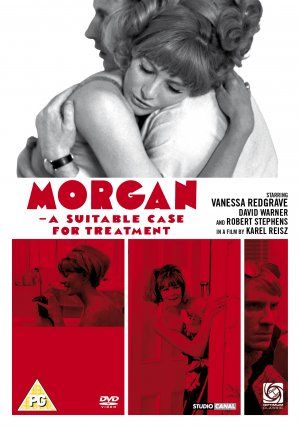 Morgan! (called Morgan: A Suitable Case for Treatment in the opening titles) is a London-set romantic farce that was produced around the same time as Georgy Girl. It has dated even worse. Director Karel Reisz and scenarist David Mercer have the same basic goal as the Georgy Girl filmmakers. They were looking to adapt the style of the French nouvelle vague films to commercial comedy. And as in Georgy Girl, the effect of mating that material with the existential aesthetic of the French is ludicrous. Of the two, Georgy Girl is the easier to take, largely because it has a plot. Morgan! is little more than a collection of slapstick setpieces that wouldn't have been out of place in a Three Stooges short. The ostensible story is about the efforts of a pathologically childish working-class artist (David Warner) to woo back his upper-class ex-wife (Vanessa Redgrave) before she marries her new beau. But there's little in the way of dramatic construction, and the naturalistic manner of the film works against the humor of the slapstick and other farcical elements. The filmmakers seem engaged in a futile effort to make stalking, vandalism, and kidnapping funny. The picture has a number of 1960s "with it" touches, such as the Warner character's fascination with Communist leaders and imagery, but they're strictly decorative. The same is true of his interest in gorillas and other apes. The cutaways to clips from African wildlife documentaries, Johnny Weissmuller Tarzan films, and the original King Kong never connect to anything more than pretension. Karel Reisz and cinematographer Larry Pike do a superficially capable job of staging and shooting scenes in location settings. It would have been interesting to see them use those skills with compatible material.
Thursday, February 9, 2012
Short Take: A Man and a Woman
This review was originally published on Pol Culture.
 A Man and a Woman is shallow, glib, and absolutely gorgeous. The story isn’t much. It’s about the tentative romance between a widow (Anouk Aimée) and a widower (Jean-Louis Trintignant). They are both in their thirties, and they meet at their respective children’s boarding school. Claude Lelouch, who directed, co-wrote the script, and provided the outstanding cinematography, suffuses everything with glamour. The Aimée and Trintignant characters are beautiful, charming people with dream professions: she’s a film-production script supervisor; he races cars at Le Mans and Monte Carlo. Every scene looks like the basis for what would be some of the finest slick-magazine advertising layouts ever published. One may want to bask in the characters and settings, which, like the best advertising imagery, manage to be romantic and down-to-earth simultaneously. Beyond that, the attraction of the film is Lelouch’s extraordinary cinematic showmanship. He makes extensive use of the stylistic hallmarks of peers such as Antonioni, Godard, and Truffaut--the documentary locations, the naturalistic dialogue and acting, the modernist use of technique as a content in itself, among many others--but he doesn’t employ them for dramatic or poetic effect. He uses them decoratively, and his facility and resourcefulness in this are remarkable. It is hard not to marvel at Lelouch’s elegance; he turns slickness into an art. The famous score is by Francis Lai.
 A Man and a Woman is shallow, glib, and absolutely gorgeous. The story isn’t much. It’s about the tentative romance between a widow (Anouk Aimée) and a widower (Jean-Louis Trintignant). They are both in their thirties, and they meet at their respective children’s boarding school. Claude Lelouch, who directed, co-wrote the script, and provided the outstanding cinematography, suffuses everything with glamour. The Aimée and Trintignant characters are beautiful, charming people with dream professions: she’s a film-production script supervisor; he races cars at Le Mans and Monte Carlo. Every scene looks like the basis for what would be some of the finest slick-magazine advertising layouts ever published. One may want to bask in the characters and settings, which, like the best advertising imagery, manage to be romantic and down-to-earth simultaneously. Beyond that, the attraction of the film is Lelouch’s extraordinary cinematic showmanship. He makes extensive use of the stylistic hallmarks of peers such as Antonioni, Godard, and Truffaut--the documentary locations, the naturalistic dialogue and acting, the modernist use of technique as a content in itself, among many others--but he doesn’t employ them for dramatic or poetic effect. He uses them decoratively, and his facility and resourcefulness in this are remarkable. It is hard not to marvel at Lelouch’s elegance; he turns slickness into an art. The famous score is by Francis Lai.
Thursday, January 19, 2012
Short Take: Alfie
This review was originally published on Pol Culture.
 Alfie’s title character, a swaggering Cockney ladies’ man, may be Michael Caine’s greatest role. Caine makes Alfie both charming and repellent. He plays this cynical womanizer with bravado, and he’s nothing less than riveting. His skill is considerable. Like Laurence Olivier’s Richard III, the character addresses the audience with asides throughout the action of the scenes, and Caine paces the shifts so deftly that one watches him all but in awe. His performing charisma is imperative, as the film would be oppressive otherwise. Bill Naughton’s script, based on his play, is not the least bit interested in entertaining the audience with Alfie’s rakish behavior; the purpose is to indict him for it. The audience’s nose is rubbed in the character’s misogyny from the outset. He takes pride in casting women aside when they become inconvenient, and his relationships with his kept “birds”--the ones he shacks up with--seem based entirely on breaking down the women’s self-esteem. The scenes with the live-in girlfriends (Julia Foster and Jane Asher) don’t have a moment of levity in them. The greatest pathos is reserved for Vivien Merchant’s character, a lonely housewife whose dalliance with Alfie results in an unwanted pregnancy. After Caine, the liveliest performer is Shelley Winters. Her scenes are the only ones shaped for ribald laughs, and she plays them with zest. (She’d have been a great Wife of Bath.) The director, Lewis Gilbert, seems to think more in theater terms than cinematic ones. He doesn’t make the extensive London location shooting feel integral, and his staging of a barroom fight is hopeless. But his handling of the actors in the dialogue scenes is largely impeccable. He deserves a great deal of credit for making Caine’s triumph possible. The fine jazz score was written and performed by Sonny Rollins. Burt Bacharach and Hal David wrote the mediocre title song, performed by Cher, with Sonny Bono producing. A remake of the film starring Jude Law was released in 2004.
 Alfie’s title character, a swaggering Cockney ladies’ man, may be Michael Caine’s greatest role. Caine makes Alfie both charming and repellent. He plays this cynical womanizer with bravado, and he’s nothing less than riveting. His skill is considerable. Like Laurence Olivier’s Richard III, the character addresses the audience with asides throughout the action of the scenes, and Caine paces the shifts so deftly that one watches him all but in awe. His performing charisma is imperative, as the film would be oppressive otherwise. Bill Naughton’s script, based on his play, is not the least bit interested in entertaining the audience with Alfie’s rakish behavior; the purpose is to indict him for it. The audience’s nose is rubbed in the character’s misogyny from the outset. He takes pride in casting women aside when they become inconvenient, and his relationships with his kept “birds”--the ones he shacks up with--seem based entirely on breaking down the women’s self-esteem. The scenes with the live-in girlfriends (Julia Foster and Jane Asher) don’t have a moment of levity in them. The greatest pathos is reserved for Vivien Merchant’s character, a lonely housewife whose dalliance with Alfie results in an unwanted pregnancy. After Caine, the liveliest performer is Shelley Winters. Her scenes are the only ones shaped for ribald laughs, and she plays them with zest. (She’d have been a great Wife of Bath.) The director, Lewis Gilbert, seems to think more in theater terms than cinematic ones. He doesn’t make the extensive London location shooting feel integral, and his staging of a barroom fight is hopeless. But his handling of the actors in the dialogue scenes is largely impeccable. He deserves a great deal of credit for making Caine’s triumph possible. The fine jazz score was written and performed by Sonny Rollins. Burt Bacharach and Hal David wrote the mediocre title song, performed by Cher, with Sonny Bono producing. A remake of the film starring Jude Law was released in 2004.
Tuesday, January 10, 2012
Short Take: Lord Love a Duck
This review was originally published on Pol Culture.
 Tuesday Weld gives a terrific comic performance as Barbara Ann Greene, the teen beauty at the center of director George Axelrod’s Lord Love a Duck. Barbara Ann dreams of success and for everyone to love her. The day before classes start at her new school, she meets Alan (Roddy McDowell), an eccentric genie of a boy who makes it all happen. With Alan’s help, Barbara Ann connives her way into a new wardrobe, the school’s most popular clique, a job as the principal’s secretary, a marriage to a wealthy husband, and finally stardom as a beach-movie leading lady. The flirty ingenuousness, the little-girl drawl, the glee at surprises and acquiring things--they all make Weld’s Barbara Ann irresistible. There’s no doubt she’s a girl for whom men would do anything. The film is at its funniest when she guilelessly baits, hooks, and reels them in. Weld's knack for comic boredom and petulance is also a delight. It's too bad the film is otherwise a poorly executed mess. There’s no momentum to the story, and the satirical jabs at 1960s culture are much too broad to be effective. Axelrod’s staging is iffy by the standards of TV sitcoms. He also directs most of the cast to overdo everything. Some of Weld’s best moments--such as when Barbara Ann shops for sweaters with her father (Max Showalter), or her job interview with the school principal (Harvey Korman)--are nearly wrecked by her co-stars' mugging. There are also occasional problems with tone: Lola Albright gives a fine dramatic performance as Barbara Ann’s self-destructive mother, but it's completely out of place in a madcap comedy. The screenplay, credited to Larry H. Johnson and Axelrod, is based on the novel by Al Hine.
 Tuesday Weld gives a terrific comic performance as Barbara Ann Greene, the teen beauty at the center of director George Axelrod’s Lord Love a Duck. Barbara Ann dreams of success and for everyone to love her. The day before classes start at her new school, she meets Alan (Roddy McDowell), an eccentric genie of a boy who makes it all happen. With Alan’s help, Barbara Ann connives her way into a new wardrobe, the school’s most popular clique, a job as the principal’s secretary, a marriage to a wealthy husband, and finally stardom as a beach-movie leading lady. The flirty ingenuousness, the little-girl drawl, the glee at surprises and acquiring things--they all make Weld’s Barbara Ann irresistible. There’s no doubt she’s a girl for whom men would do anything. The film is at its funniest when she guilelessly baits, hooks, and reels them in. Weld's knack for comic boredom and petulance is also a delight. It's too bad the film is otherwise a poorly executed mess. There’s no momentum to the story, and the satirical jabs at 1960s culture are much too broad to be effective. Axelrod’s staging is iffy by the standards of TV sitcoms. He also directs most of the cast to overdo everything. Some of Weld’s best moments--such as when Barbara Ann shops for sweaters with her father (Max Showalter), or her job interview with the school principal (Harvey Korman)--are nearly wrecked by her co-stars' mugging. There are also occasional problems with tone: Lola Albright gives a fine dramatic performance as Barbara Ann’s self-destructive mother, but it's completely out of place in a madcap comedy. The screenplay, credited to Larry H. Johnson and Axelrod, is based on the novel by Al Hine.
Wednesday, January 4, 2012
Short Take: Seconds
This review was originally published on Pol Culture.
 Seconds (1966) is often considered the third film in director John Frankenheimer’s so-called “paranoia” trilogy, after The Manchurian Candidate (1962) and Seven Days in May (1964). It tells of a New York banker (John Randolph) who, dissatisfied with his life, falls into the clutches of an underground business that offers him the opportunity to start again in a new identity. Coerced into accepting, he is subjected to radical plastic surgery and, played from that point on by Rock Hudson, takes over the life of a California-based painter. But he has trouble adjusting, and he ultimately runs afoul of the company that gave him his new life. The script by Lewis John Carlino, based on the novel by David Ely, is a macabre suspenser that satirizes the unfulfilling conformity of America’s success-driven culture. Frankenheimer, working with the superb cinematographer James Wong Howe, comes up with a visual style that serves it brilliantly. The Hudson character is told at one point, “You are in your own dimension.” Frankenheimer and Howe seem to apply that idea to every visual element: everyone and everything seems to exist on its own plane of reality. Everybody seems isolated from everyone else, and interaction invariably feels as if the participants’ space is being invaded. It’s a superb visual analogue for anxiety and alienation. These effects are most dazzling in the non-studio location shooting; the characters often seem imposed onto the footage of the activity around them. The technique reaches its crescendo in a bacchanal sequence where Frankenheimer turns the meaning in on itself; the usual tack is followed of emphasizing the Hudson character’s discomfort at what’s going on, but the character is then elegantly integrated into the action when he gives over to the celebration. The camera angles occasionally get needlessly hyperbolic, but those are hiccups. The story could use some more snap, and Hudson's performance is flatter than stale soda, but this is still one of most impressive Hollywood films of the 1960s.
 Seconds (1966) is often considered the third film in director John Frankenheimer’s so-called “paranoia” trilogy, after The Manchurian Candidate (1962) and Seven Days in May (1964). It tells of a New York banker (John Randolph) who, dissatisfied with his life, falls into the clutches of an underground business that offers him the opportunity to start again in a new identity. Coerced into accepting, he is subjected to radical plastic surgery and, played from that point on by Rock Hudson, takes over the life of a California-based painter. But he has trouble adjusting, and he ultimately runs afoul of the company that gave him his new life. The script by Lewis John Carlino, based on the novel by David Ely, is a macabre suspenser that satirizes the unfulfilling conformity of America’s success-driven culture. Frankenheimer, working with the superb cinematographer James Wong Howe, comes up with a visual style that serves it brilliantly. The Hudson character is told at one point, “You are in your own dimension.” Frankenheimer and Howe seem to apply that idea to every visual element: everyone and everything seems to exist on its own plane of reality. Everybody seems isolated from everyone else, and interaction invariably feels as if the participants’ space is being invaded. It’s a superb visual analogue for anxiety and alienation. These effects are most dazzling in the non-studio location shooting; the characters often seem imposed onto the footage of the activity around them. The technique reaches its crescendo in a bacchanal sequence where Frankenheimer turns the meaning in on itself; the usual tack is followed of emphasizing the Hudson character’s discomfort at what’s going on, but the character is then elegantly integrated into the action when he gives over to the celebration. The camera angles occasionally get needlessly hyperbolic, but those are hiccups. The story could use some more snap, and Hudson's performance is flatter than stale soda, but this is still one of most impressive Hollywood films of the 1960s.
Saturday, December 31, 2011
Short Take: Georgy Girl
This review was originally published on Pol Culture.
 The British romantic farce Georgy Girl was a critical and commercial hit back in 1966. In general, it has not dated well. The picture appropriates the hallmarks of the French nouvelle vague films of Jean-Luc Godard and François Truffaut, but without making those elements feel intrinsic to the material. The filmmakers seem to be working their way through a checklist. The happy-go-lucky young protagonists, the extensive use of urban locations, the handheld camerawork, the naturalistic lighting and sets, the gritty social detail--they’re all there, and the picture’s dubious distinction is that it makes one appreciate the French films even more. The director, Silvio Narizzano (he’s Canadian), and the screenwriters, Margaret Forster and Peter Nichols, have a sitcom sensibility. The effect of mating that with the existential aesthetic of their French contemporaries is ludicrous. A slightly chubby Lynn Redgrave plays the title character, a young working-class woman who feels inadequate next to her beautiful roommate (Charlotte Rampling). She spends much of her time dodging the amorous interest of her parents’ employer (James Mason). Complicating things further is her growing attraction to her roommate’s boyfriend, a hyperactive goofball played by Alan Bates. The actors leave one feeling the broad contrivance and humor are beneath their talents, but the only one who transcends the silliness is Charlotte Rampling. She walks away with nearly every scene she’s in. Her bitchy hauteur dries out the material, and she turns almost every line into a zinger. She’s the only member of the cast who is consistently laugh-out-loud funny. The great mystery of the film’s commercial success is that it didn’t make her a star. Ken Higgins’ Oscar-nominated cinematography is an accomplished approximation of Raoul Coutard and Henri Decaë’s work in the film’s French forebears. The cheesy though memorable theme song is performed by The Seekers.
 The British romantic farce Georgy Girl was a critical and commercial hit back in 1966. In general, it has not dated well. The picture appropriates the hallmarks of the French nouvelle vague films of Jean-Luc Godard and François Truffaut, but without making those elements feel intrinsic to the material. The filmmakers seem to be working their way through a checklist. The happy-go-lucky young protagonists, the extensive use of urban locations, the handheld camerawork, the naturalistic lighting and sets, the gritty social detail--they’re all there, and the picture’s dubious distinction is that it makes one appreciate the French films even more. The director, Silvio Narizzano (he’s Canadian), and the screenwriters, Margaret Forster and Peter Nichols, have a sitcom sensibility. The effect of mating that with the existential aesthetic of their French contemporaries is ludicrous. A slightly chubby Lynn Redgrave plays the title character, a young working-class woman who feels inadequate next to her beautiful roommate (Charlotte Rampling). She spends much of her time dodging the amorous interest of her parents’ employer (James Mason). Complicating things further is her growing attraction to her roommate’s boyfriend, a hyperactive goofball played by Alan Bates. The actors leave one feeling the broad contrivance and humor are beneath their talents, but the only one who transcends the silliness is Charlotte Rampling. She walks away with nearly every scene she’s in. Her bitchy hauteur dries out the material, and she turns almost every line into a zinger. She’s the only member of the cast who is consistently laugh-out-loud funny. The great mystery of the film’s commercial success is that it didn’t make her a star. Ken Higgins’ Oscar-nominated cinematography is an accomplished approximation of Raoul Coutard and Henri Decaë’s work in the film’s French forebears. The cheesy though memorable theme song is performed by The Seekers.
Thursday, December 29, 2011
Short Take: Cul-de-Sac
This review was originally published on Pol Culture.

Roman Polanski’s third feature, Cul-de-Sac (1966), is like The Desperate Hours--as reimagined, perhaps, by Samuel Beckett in collaboration with Edward Albee and Harold Pinter. An American gangster in England (Lionel Stander), fleeing a botched robbery, hides out in the beachfront castle home of a retired factory owner (Donald Pleasance) and his young French wife (Françoise Dorléac). The gangster holds the couple captive while waiting for his confrères to pick him up. The film doesn’t play this scenario for melodramatic suspense. The story is simply the pretext for a series of comic dialogues and confrontations between the gangster, the couple, and at one point, friends of the couple who pay an unannounced visit. The script, by Polanski and Gérard Brach, hilariously pastiches the absurdism of Beckett, the passive-aggressive portent of Pinter, and the farcical hostilities of Albee. As a director, Polanski is in peak form: the tempo of the scenes is masterful, and the dark, humorous tone is beautifully sustained throughout. In some scenes, such as the single-take beach confrontation between the gangster and the factory owner, or the mad slapstick finale, Polanski’s virtuosity is all but astonishing. Stander and Pleasance, generally erratic actors, rise to the occasion here; they both deliver first-rate comic performances. Dorléac (Catherine Deneuve’s older sister) isn’t as entertaining, but her ugly eye make-up notwithstanding, she’s at least pleasant to look at. Gilbert Taylor provides the fine black-and-white cinematography. The jazz score, with its unsettling electronic touches, is by Krzysztof Komeda.

Roman Polanski’s third feature, Cul-de-Sac (1966), is like The Desperate Hours--as reimagined, perhaps, by Samuel Beckett in collaboration with Edward Albee and Harold Pinter. An American gangster in England (Lionel Stander), fleeing a botched robbery, hides out in the beachfront castle home of a retired factory owner (Donald Pleasance) and his young French wife (Françoise Dorléac). The gangster holds the couple captive while waiting for his confrères to pick him up. The film doesn’t play this scenario for melodramatic suspense. The story is simply the pretext for a series of comic dialogues and confrontations between the gangster, the couple, and at one point, friends of the couple who pay an unannounced visit. The script, by Polanski and Gérard Brach, hilariously pastiches the absurdism of Beckett, the passive-aggressive portent of Pinter, and the farcical hostilities of Albee. As a director, Polanski is in peak form: the tempo of the scenes is masterful, and the dark, humorous tone is beautifully sustained throughout. In some scenes, such as the single-take beach confrontation between the gangster and the factory owner, or the mad slapstick finale, Polanski’s virtuosity is all but astonishing. Stander and Pleasance, generally erratic actors, rise to the occasion here; they both deliver first-rate comic performances. Dorléac (Catherine Deneuve’s older sister) isn’t as entertaining, but her ugly eye make-up notwithstanding, she’s at least pleasant to look at. Gilbert Taylor provides the fine black-and-white cinematography. The jazz score, with its unsettling electronic touches, is by Krzysztof Komeda.
Subscribe to:
Posts (Atom)